
We look forward to screening the film of the play by Italian playwrights Dario Fo and Franca Rame in time for their Centenary celebrations in 2026. For more information about theatre productions and their work – see here


We look forward to screening the film of the play by Italian playwrights Dario Fo and Franca Rame in time for their Centenary celebrations in 2026. For more information about theatre productions and their work – see here
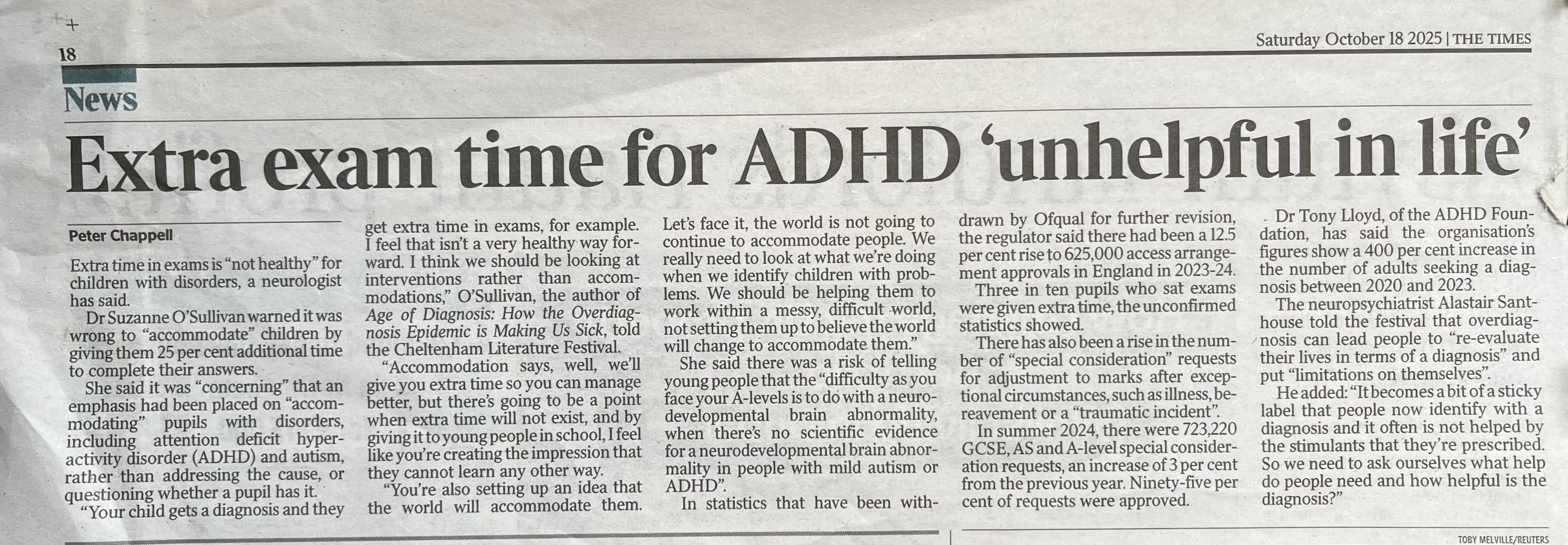
How helpful is the diagnosis asks neuropsychiatrist Alistair Santhouse at the Cheltenham Literary festival? He is there to discuss Dr Suzanne O Sullivan’s new book “Age of Diagnosis – how the overdiagnosis epidemic is making us sick”. And I can feel my hackles rising at the thought of ADHD kids under attack again. We teachers know they are little blighters in the classroom, but we also know that ADHD does not affect intelligence, just ability to learn – so they deserve just as much success as other children.
This time, what little help ADHDers can get around public exams is being challenged by neurologists who are arguing over the semantics of “accommodations” versus “interventions”. That they should look for the “cause” of the problem rather than “adapt” to the child. This seems a throwback to 1904 when ADHD was first written about in the medical journal – The Lancet. We know the cause – what are you doing to help those with it?
Buying into a media trope that ADHD is overdiagnosed and these diagnoses (which can only be given by a specialist ADHD psychiatrist) are just handed out willy nilly, is a disaster. In 2023, the ADHD Foundation conference on women and ADHD had the statistic that 75% of women are undiagnosed. What is “unhelpful” is not the diagnoses, but the leaning in to people’s fears about overdiagnosis and fanning the flames in the media. This is a very real learning disorder, that can severely impact a child’s life chances, they deserve all the interventions and accommodations they can be given.
Read more: A really ‘unhelpful’ stance for ADHDersIn her new book, O Sullivan also says that extra exam time for ADHD is “unhelpful in life”? How can that be so? Don’t they need those qualifications just as much as the next neurotypical child, and aren’t they just asking for extra time to take some of the very real physiological terror and performance anxiety that often comes with the prospect of public exams. They are not asking for a different exam paper, maybe just the chance to take the exam in a different environment where they are not going to feel such panic that nothing of their learning will ever make it onto the paper. This, O Sullivan says, is setting pupils up for “accommodations” in life that they might not have access to.
And the last time I looked, ADHD counts as a protected characteristic in law, so those with neurodevelopmental disorders are also entitled to accommodations in the workplace if they need them going forward in life. That is the whole point of having a diagnosis, it can help you mitigate symptoms by being aware of, say, ‘time blindness’ or ‘distractibility’, and it can also give you a good reason to fight your corner if a small adjustment might make all the difference. I know because as an ADHDer myself I have asked for an accommodation in the workplace in one of the schools where I worked, and was given a small study where once I was working across 13 different classrooms.
Fortunately, I am not alone in thinking that if this stance takes hold it is a dangerous one. Yesterday, Sir Ian Bauckham, Chief Regulator of Ofqual waded in on the letters’ pages of the Times reminding everyone that the number of children with extra time in exams matched the number of SEND children – and these SEND children not only need their access arrangements, they are a legal entitlement.
It was inevitable that we would have a kickback at what is deemed overdiagnosis, because for some parents it smacks of unfairness, but it is far more unfair to take away the few accommodations that exist for ADHD or ASD children, who aren’t asking for easier exams, just easier conditions that don’t overwhelm them when taking them. And since when did sitting in a Sports Hall with hundreds of other children ever become a skill that we all have to learn for later in life?
“Accommodation says, well, we’ll give you extra time so you can manage better, but there’s going to be a point when extra time will not exist, and by giving it to young people in school, I feel like that you’re creating the impression that they cannot learn any other way”, said O’ Sullivan at the Cheltenham Literary Festival. Thus spoke a neurotypical who is not prepared to step into the shoes of a neuro-atypical and consider how much harder it is for them to perform, let alone learn in a busy classroom, in these conditions. Currently more than a third of sixteen year olds leave school without a pass in GCSE English and Maths, and that is with the accommodations – remember the extra time is only in exams, nowhere else in the school curriculum.
To answer the question of psychiatrist Alistair Santhouse interviewing the author: “how helpful is a diagnosis?” I would answer – extremely. And I would vehemently push back at the premise that “the overdiagnosis epidemic is making us sick”, part of the title of O Sullivan’s book. What is making children and parents sick is the fight to make it through a brutal and hostile mainstream school system, without help. SEND kids need more, not less help. And any stance suggesting otherwise is not only “unhelpful”, it could be illegal.
As well as posting a recent review of my own book Better Late Than Never on adult ADHD – I wanted to highly recommend a fantastic new book out by Kat Brown called “It’s Not a Bloody Trend!” (love that title). It launched this February, and I have already finished it because it is a galloping and brilliant piece of writing. It successfully brings together different voices as well as Kat’s own nuanced but never sorry-for-herself exploration of her own ADHD. Even when she described her nickname as “Robogob” at school, which made me drop the book with a cruel hoot, she is measured in her approach in how neurodiversity has affected her life.
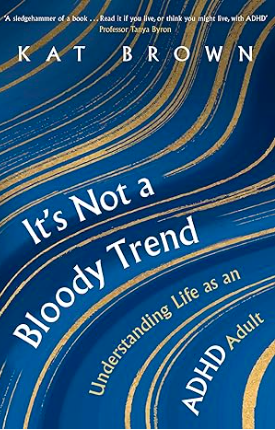
The research that has gone into the book is properly thorough, and she has got a good variety of people involved from the esteemed CEO of the ADHD Foundation Dr Tony Lloyd to the average Joe, and there are plenty of interviews so everyone’s experience is valid.
Anyone who is exploring their own ADHD would do well to buy this, because it genuinely adds to the sum of human understanding on this complex neurological difference, and my link above is to the Bookshop.org because I don’t use Amazon (they don’t pay tax in this country and have devastated sales in High Street Bookshops). Copies bought through Bookshop.org donate to a fund for independent booksellers, and over £3.4m has been donated to date through them.
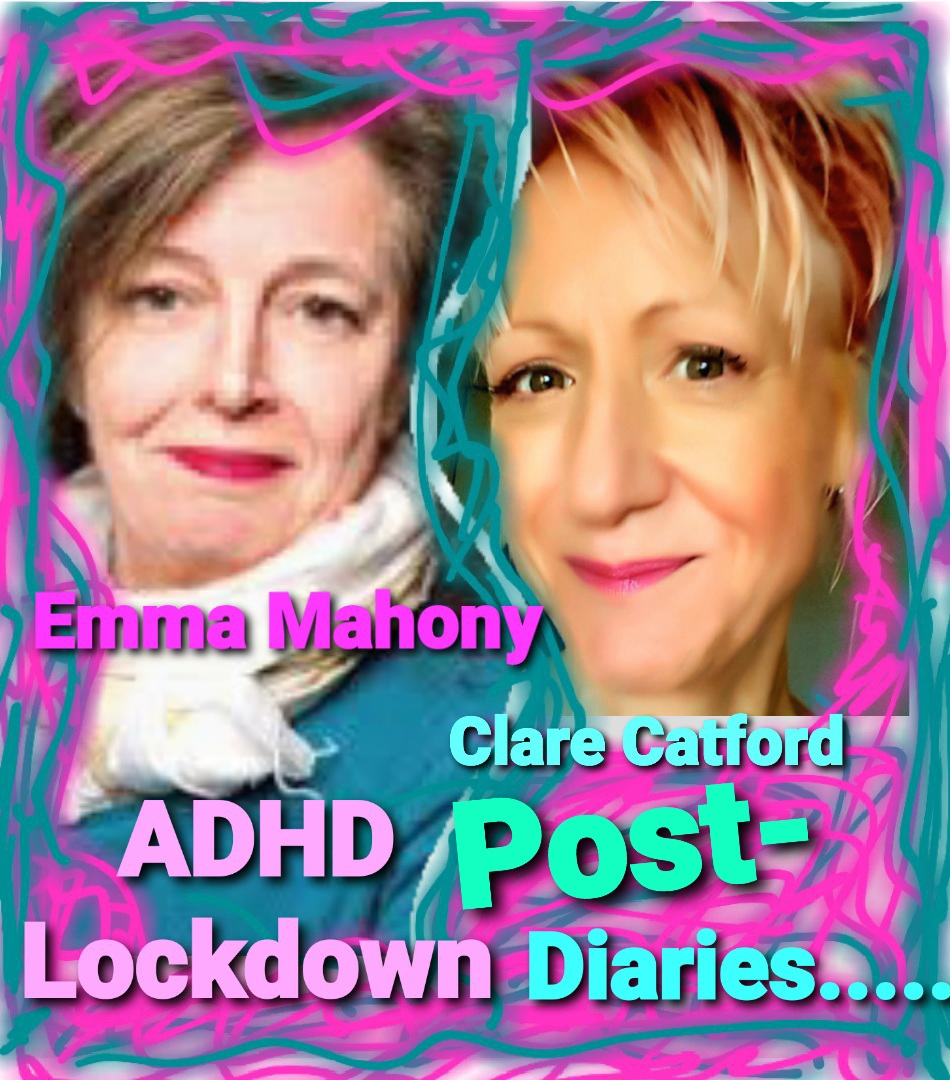
Journalist Emma Mahony and Broadcaster Clare Catford look back at the close of October ADHD awareness month and talk about how to have a “Medication Vacation” following yesterday’s piece in the Sunday Times – detailing how roughly 200,000 patients are experiencing a shortage in their ADHD medication supply, which could last till Christmas. GPs have been told not to start new patients on any medication during the shortage. How can you get extra support at work being “out” about your ADHD?
Commissioned by the Teaching website Teachit to write this piece on supporting students with ADHD in a mainstream classroom, I couldn’t resist offering a mini-glimpse of the challenges for the average teacher (let alone a neurodiverse one). The result is this short piece that was published in April 2023 but has been retweeted and reposted throughout ADHD Awareness month this October to remind educators that there is always another way. Not necessarily better, but another.

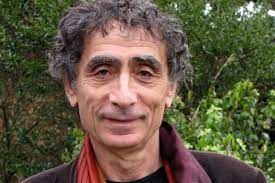
In this episode of the ADHD Post-Lockdown diaries, author and educator Emma Mahony and broadcaster and journalist Clare Catford explore their shared view of physician Gabor Maté’s theories about ADHD, which he himself has and two of his children. Despite this, he argues that it is not hereditary but the result of early trauma and lack of attunement. Most recently he argued this when he diagnosed Prince Harry in an interview. What’s your view?
What did you last read on neurodiversity? If you haven’t read any of these books – here are some of the latest thinkers and scientists writing accessibly on how the brain works. It’s good to see ADHD in the mix with my book ‘Better Late than Never’ included. https://www.penguin.co.uk/articles/2023/01/neurodiversity-books-characters-memoir-diagnosis

Author, journalist and teacher Emma Mahony along with broadcaster and media consultant Clare Catford discuss during new(ish) year resolutions and how helpful dangling year-long intentions are in front of an ADHDer’s brain.

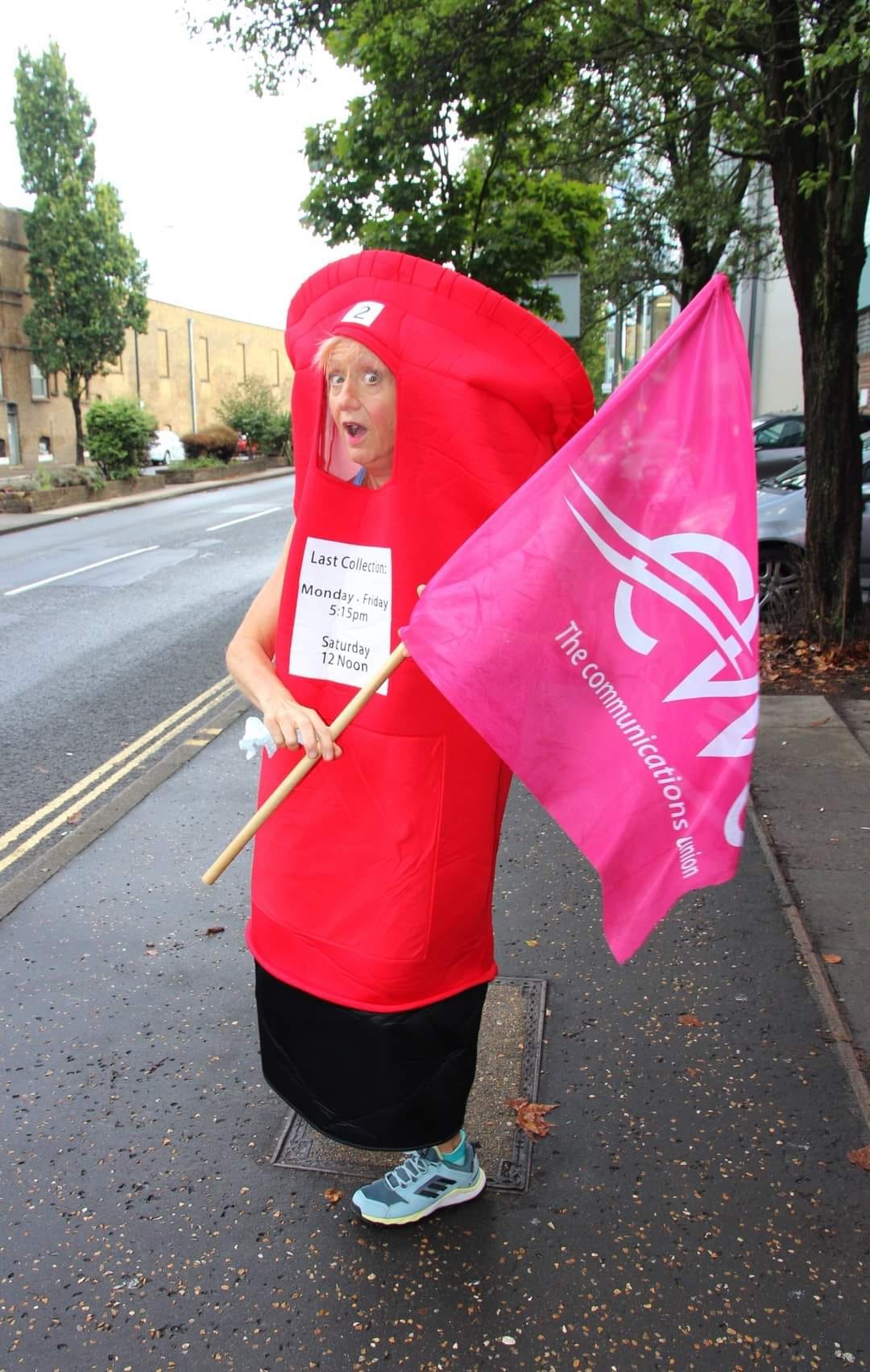
This ADHD Awareness month, Author and Teacher Emma Mahony and Broadcaster and Podcaster Clare Catford encourage ADHD-ers to follow their gut and take a risk, after years of feeling “wrong” in a neuro-typical world. How risk-taking can be a strength of an ADHD diagnosis, not a curse. As Clare demonstrates while protesting on behalf of the Posties…
On the eve of travelling up to the ADHD Foundation conference, author Emma Mahony and broadcaster Clare Catford explore the different reactions to their parents dying recently and ask whether it is “me or the ADHD”?
 Better Late than Never